Showing posts with label France. Show all posts

Sunday, April 26, 2009

April 25th - Marseilles & Bandol


4-25-09 – Marseilles & Bandol

Michel and Anna invited me to go to Bandol, to perhaps go sailing on Michel’s sailboat. I met them in front of the hotel , and we left in their car. We drove down the Rhone valley, past Aix-en-Provence, Mont Luberon, and down toward the coast. Provence has beautiful countryside, orderly farms, planted in espaliered fruit trees, with tall cypress and platane trees lining the fields to protect against le Mistral. At the same time, it still seems very wild and natural; the homes are built from the same rock of the mountains and hills all around, and the scrubby ‘Garrigue’ brush is largely composed of wild herbs and flowers that blend seamlessly into the edges of the farms themselves. It is difficult to see where nature ends and the hand of man is a very subtle thing here.

About an hour into the drive, we went through a tunnel, and emerged with the sea in sight, and Marseilles spread out before us. This is a major seaport – ships of every description were in evidence, loading and unloading cargo from around the world. Ferries from here reach Rome, Corsica, Barcelona, Genoa, Beirut, Alexandria, Lybia, Morocco, and Algeria. Humans have lived around here for 30,000 years, evidenced by cave paintings in the area - It was established as a seaport by the Phonecian Greeks 3,000 years ago, and was important to every power since. The Vieux Port is still bustling within its very sheltered walls, but today it is filled with pleasure boats, instead of the vessels of commerce which used to bring the wealth of the world here. We crept up on the road along the Cornice, where you can view out to sea. It is possible to see the islands where the Count of Monte Cristo was supposed to have been held as a captive, and he escaped by swimming away in the sea.

From here, we turned a bit inland, and followed the motorway toward Toulon. We passed Cassis, which is famous for the Calanques – a landscape of high mountains that fall into secluded fijord-like grottos – perfect for boating and swimming. We arrived soon at Bandol, which is both a larger wine region made up of several villages, and a small seaside city. We found Michel’s boat, the Llhassa, which is about a 40’ sailing boat, and set up aboard. The wind was blowing between 25 and 40 knots while we were there, and the entire harbor was filled with the sound of whistling rigging of the hundreds of boats in the marina. We had lunch on the boat, and enjoyed the combination of warm sun with cooling breezes. It was far too windy to go out sailing – outside the protection of the harbor, the sea was whipped into whitecaps, even within the sheltered bay.

We walked the waterfront, checking out the boats – some of them were quite impressive megayachts – also the motorcycle variety was very good! Many groups of people were playing Petanque on the crushed granite boules court – I guess that this is the Provencale sport, and perfect for a breezy Saturday afternoon with one’s friends!

After several hours, we packed our things and left to visit a Domaine owned by friends of Anna & Michel. We drove up into the mountains, quickly gaining altitude as we left the seaside behind. Vines appeared very quickly once we rounded the first bend from the sea, and as we appeared in a higher valley, every hillside was terraced and planted to vines all around.

We arrived at the Domaine de La Laidière, high above the valley floor and with a commanding view of the village of Sainte Anne d’Evenos. We were received by Freddy Estienne, who owns the Domaine. His father and grandfather established the estate in 1941, with some small vineyards which are still owned by the family, and began to produce wine. Since then, they have purchased other vineyards slowly and reclaimed an impressive high terraced slope above the winery which had fallen into disuse over many years, replanting the traditional cepages of Mourvedre, Grenache and Cinsault.

Freddy makes his wines very traditionally, but uses stainless steel, temperature controlled fermentors for the initial fermentation and then ages the wines in large wooden foudres for about 18 months for the reds. He only buys a new foudre every year or two, so the wines are not at all dominated by the wood, but instead stand on the strength of the wines themselves.

We tasted many wines – the white and rose are beautifully refreshing. The rose is a direct pressed wine, meaning that it does not remain on the skins for any time at all, and as such is a pale, delicious, fresh wine. The reds are deep and serious, relying heavily upon the Mourvedre – a grape that produces deep, richly textured wines with aromas of rich earth, blackfruits, and sometimes even leather and blood (this is a good thing, a very good thing!) He opened many vintages for us, both from recent bottlings as well as dating back to 1993.

At the end of our tasting, he beckoned us downstairs into the storage cellar for bottled wines. He has a collection of bottles going back to the first years of the estate, under his father and grandfather. He selected a bottle from his dwindling supply of the 1950 vintage, and brought it upstairs, opening it for us in an overwhelming show of generosity. It was aged, but still vibrant and alive, and amazingly consistent with the younger wines we had been sampling.

This is what wine can be about – it can become more than just a beverage, more than just an art or craft or agriculture, or hobby. To imagine the efforts and toils that Freddy’s grandfather and father endured to bring this wine to bottle – it is staggering. To realize their belief in the terroir of Bandol itself (theirs was one of the Domaines which were instrumental in developing the Appellation d’Origine Controlee for Bandol,) and then to taste the wine which came from their early vintages here in this place – it was to see how wine can also become a thread of history and of place. It ties the generations of their family together, and ties them to this place where they have made their lives. It is a bit of time-travel, a chance to taste the still-lingering fruit from that long-ago summer, and to remember all that has changed since. And yet the continuity between each of the bottles we tasted reminds one of all that does not change – the terroir, the cycle of the sun & seasons, the rhythms of life.

Merci Beaucoup, Beaucoup, Beaucoup, Freddy for sharing this precious bottle with us and for connecting us with your family and your sublime place as well. I will always remember this show of generosity!

www.laidiere.com

April 24th - Chateauneuf du Pape & Orange


4/24/09 – Avignon / Chateauneuf du Pape / Orange:

I arrived from Paris on the TGV and went to collect my rental car. At the office, it quickly became apparent that the rental was going to be a lot more expensive than I had expected from the online quote – mostly because I needed to rent it in Avignon, to be returned in Montpellier, and the expense for a one-way rental was astronomical. On top of that, they would not rent to me a GPS for a one-way rental. I decided to skip it, and took the shuttle into Avignon to check into my hotel.

Once I was on the shuttle, I telephoned to Victor’s father, (Victor is a French Oenology / Viticulture student whom will become an intern with us at Eos this harvest,) Daniel, to let him know that I was in Avignon. He arranged to meet me at 2pm, and we went up the Rhone river about 10 miles to Chateauneuf du Pape. We visited several of the Domaine Beaurenard vineyard sites within Chateauneuf du Pape, and met several of the vineyard workers, who were hand-weeding around the vines. There were so many rocks that the tools they were using were the sturdiest hoes that I had ever seen, complete with a backside of the hoe that allowed them to perfectly work around the trunk of the vines. Daniel said that his system is totally organic now, and in fact he was going entirely to biodynamic viticulture, starting with this season.

Some of the vineyards that we looked at were planted in 1920 – these are some of the oldest vines in their domaine. Daniel said that he is the seventh generation of his family in the vineyards – they have a barn on the property that has been in the family since approximately 1685. Even some of his workers have been there for a long time – one has been an employee for 20+ years, he started working when he was 14. And that employee’s father had worked alongside Daniel’s father, Paul Coulon for most of his career.

The oldest vineyards still producing in their domaine were planted in 1902. ‘Perhaps I will have to replace them, but they still give very good quality wine, but not so much of it’ he said. ‘Or perhaps Victor can replace them!’ It was interesting to see the soil types and how they differed throughout the areas of Chateauneuf. The oldest plantings were established in the areas where there is more clay in the soil, and less rocks. This was the most fertile, and easiest to farm ground. As this land became scarce, growers moved up into the areas where the glaciers deposited mountains of stones. In some places, more than 90% of the soil is made up of rocks! These rocks can reach up to 200 feet deep in places, so they are very well drained. The stones came from as far away as the Alps, carried by the massive glaciers that scoured the valley of the Rhone, and were dropped here when the glacier turned.

In some of these secondary areas, there are huge mounds of stones – the farmers wives used to have the task of carrying stones out of the vineyards, in order to make it easier for the horses to work in the vines. But as many as they pulled up, more shifted up from under the earth – so today there are just as many stones, but many of the vineyards have margins with banks of stones piled up around them. It still would be easy to turn your ankle out here – it is quite incredible!

Daniel told me about a specialist whom he had met with several weeks before. This person is a horticulturalist who works with understanding soil condition and health by analyzing the weeds that grow on the floor of the vineyard. By looking at the type and biodiversity of the species represented, he can tell whether the soil is in a sustainable place, or if it is lacking nutrients, or is not a stable mix of types. This seems quite interesting to me, and quite logical - certainly the state of a soil will determine which species can become dominant in it - and the mixture of types all can give and receive different things within the soil. A stable vineyard soil should exhibit about 20-25 species in this area, according to the specialist - Daniel's vineyards have as many as 42 in some places, and the specialist said that there are no specific challenges that are apparent to him in these locations.

After several hours in the vineyard, we toured the winery, and tasted through the wines. They produce a range of wines, everything from Rose to Cote du Rhone, a very high quality Rasteau, delicious Chateauneuf Blanc, and some magnificent Chateauneuf du Pape Rouge – the wine that this region is justly famous for. The wines of Beaurenard are largely Grenache, with smaller amounts of Carignane, Mourvedre, Syrah, Cinsault. I love Chateauneuf du Pape; it walks a beautiful balance between being a strong, powerful wine of extract and heft, but at the same time it is elegant, not overly tannic, and very layered. You can clearly taste the mineral and restrained ripe red fruit character of the wine, and the use of oak is subtle and tasteful – used to support the fruit and the wine, but not to be an obvious component of the flavor of the wine.

After several hours with Daniel, I met Anna, Victor’s mother. She took me to see the city of Orange, where she grew up, and where she works now. Orange was an important Roman city when they conquered Provence. It still has a mostly intact Roman theatre which dominates the hillside in the midst of the city. It is spectacular to see the workmanship that leaves such a massive, complex structure standing after over 2000 years. This is only one of three Roman theatres in the world to still have its stage wall – the large wall that would be behind the performers – preserved (the other two are in Syria and Turkey.) This keeps the acoustics intact as they were 2000 years ago, and enables the performers to be heard clearly by every one of the 9000 seats surrounding the theater. In the warm summer evenings, there is a full schedule of Opera and other performances that still take place many evenings of the week.

Next, we headed back into Avignon. We met up with Anna’s friend, Michel, who is a pathologist in the city. We went to a restaurant which a friend of theirs had just purchased 2 weeks ago, to sit outside and have oysters. These oysters, which were from near Montpellier, are known to be a bit more salty than the Belons from near Bordeaux. I was told that when I am in Bordeaux, I must enjoy some local oysters (which I will definitely do!)

http://www.beaurenard.fr/

April 24 - Paris to Avignon


After the usual hassle of air travel in the US, it is a pleasure to be riding across France at high speed on the TGV. Easy to show up at the station, in the centre of the city, purchase a ticket with 20 minutes to spare, step onboard with my bags and be underway within minutes. I certainly hope that the US begins to adopt high-speed rail service – it makes so much sense.

It strikes me just how agricultural France really is. Only a few minutes into the travel, one escapes the 11 million plus people and congestion of Paris, and we are riding across landscapes filled with fields of mustard, alfalfa, and freshly planted fields with scarecrows erected. Forget about California’s ‘Happy Cows’ – if they could see their French cousins, with rich glossy long red coats, chest-deep in lush green pastures… Somehow the dry scrub of the western range wouldn’t seem so good at all.

Looking at the map of the travel, it appears that we are heading to the East slightly, not quite as far as Dijon, and then skirting down the backside of Burgundy, emerging in Macon. From there, we will continue down through Lyon, and next down the Rhone Valley to Avignon. This train will also stop in Aix-en-Provence and finally Marseilles, but that will be after my exit.

I am planning to pick up a rental car upon arrival and continue to Chateauneuf du Pape, to meet with Daniel Coulon, of Domaine Beaurenard. Daniel’s son, Victor, is a third-year student in Agriculture and Oeneology in Toulouse, and will be an intern for us at EOS beginning in August and through the harvest season. It will be fantastic to meet his family, they are good friends and past business partners of my former clients, Bob & Jim Varner, of Park Wine Company. They used to import many French wines from Burgundy, the Rhone, and the Midi to the United States, and formed a fast bond with the Coulon family.

I am staying in Avignon this evening. I was there last summer, and made some friends – I don’t know if I will be able to contact them or not, but I will stop by where they work and see if they are around. Since I have the car, I think that I will try to explore more of the region of Provence – I don’t have a great guide book, unfortunately, but I imagine that opportunities will present themselves. There is a village called Les Baux that sounds interesting, and I would like to visit other wine regions. I need to arrive in Montpellier Sunday to meet the group of winemakers whom I will be travelling with – Montpellier is not very far away at all, so it should be easy.
Nimes is on the way, apparently with amazing Roman artifacts, and I would love to perhaps see Arles, Aix-en-Provence, etc… Probably Saturday evening will be left to chance as far as accommodation – it could be interesting to end up in a smaller village, rather than the cities that I usually end up in – cities are good, but off the beaten track could be interesting as well.
Last year in Montpellier, I made a good friend of Philippe Chapon, who is the Chef/Owner of Tamarillo’s. His cuisine is based on flowers and fruit – very creative and delicious. One guidebook that I was looking at purchasing listed his restaurant as their choice for dining in Montpellier, and stated that Philippe taught pastry to chef Gordon Ramsay! I will ask Philippe about this on Sunday, when I see him.

We are in more forested terrain at the moment, it is difficult to look out the window without eyestrain. I suppose that we are traveling over one hundred miles per hour – possibly near two hundred.

April 23rd - Paris


I am in Paris - for the first time ever in the springtime. I think that I have only ever been here in the winter, with cool misty greyness everywhere. The light lasts until late in the evening, and the flowers and trees are all exploding in green and vibrant colors. Birds are singing everywhere, the sun is shining and everything seems perfect!

I am not here in France just to enjoy - I have meetings all the following week - a series of technical trainings with a company called 'Vivelys' which does winemaking consulting, has developed several significant winemaking technologies, and has some very exciting new sensory analysis tools with built-in multivariate statistical analysis over the internet. Those meetings begin on Sunday and stretch throughout the week to Friday - it will be with 9 US & Canadian winemakers, and we will travel from Montpellier in the South of France, upward with our final destination in Bordeaux, stopping at wineries throughout the region as we go to view case studies of the ways that their technologies have been implemented.

In addition, I am traveling this weekend to Avignon, to meet with the family of the student who will be our intern this vintage at Eos. They have a Domaine in Chateauneuf du Pape & Rasteau, just north of Avignon. It will be great to meet them and get to know something about their winemaking.

Cheers!

Saturday, July 12, 2008

Europe - Take two

I know I just returned a few weeks ago from a great couple weeks in Spain and France, but I recieved an invite on my return to travel to Portugal Spain and France to tour the cork forests and processing plants owned by the French company Oenocorc, whom I have worked with a fair bit. I mostly have used their unique DIAM product, a zero TCA engineered closure. As I am in the airport typing on my iPhone, I will talk about TCA in a further post.

I will be getting on the plane here in Philly to land tommorrow am in Lisbon, then travel across Portugal to the Spanish border at Badajoz. This is near the forests and the initial processing plant. Then we fly to Barcelona, to travel to the finishing factory in the French Pyrenees. I will even be near the Pyrenees stages of the Tour de France, and Chris said we may try to catch a bit of it.

I didn't even fully complete my last travelblog, but I guess these trips will run together.

I forgot to mention! The part of Spain where the corks grow, Extremadura, is famous for its Jamon Iberico! Stay tuned!

Sunday, July 06, 2008

Convection oven, toaster oven, and hotplate


I really love our new kitchen. The convection oven, the range with a really high-powered burner and fine control at the low-end, especially the dishwasher, and the easy access to the refrigerator, with the freezer down below, and the refrigerated shelves up top, where you can see them easily. Now I know that kitchens get fancier than ours - but this is really good compared to what I am used to, and we do just fine with this setup.

In Avignon, I got a good reminder that it is not the quality or layout of the kitchen that matters - it is ingredients, understanding of these ingredients, and organization that makes for really good food. I ducked into a wine bar with a kitchen that was turning out really solid regional food - I sat at the bar which also was the kitchen, and watched as two waitresses and one cook turned out plate after plate of food for a packed room and patio - with only a small convection oven (like the kind they use at Starbucks to heat up your disgusting breakfast sandwich thing,) a basic toaster oven, and an electric hotplate. There was a commercial dishwasher as well, and a sink, but that was essentially it! They were making oxtail, toasted sandwiches, roasted marrow bones, soups, salads, plates of cheeses, escargot, beef tartare, and many other things at a breakneck pace while keeping the diners happily plied with glasses, tastes, or bottles of wine from a blackboard listing around 30 selections.

The people next to me turned out to be friendly and fun; Franck is in the cork business, selling to wineries all around France. Kris is a baker, and sells her breads out of Les Halles, nearby. They were really fun, and we ended up going out for drinks at a friend's restaurant with an American chef. It was a great last night in France before catching the morning train back towards Barcelona.

More pictures from Avignon here:

Chateauneuf du Pape


Without question, the most famous wine region in the Southern Rhone valley is Chateauneuf du Pape. It is located within view of Avignon, and takes its name from the castle which the Avignon Popes had constructed overlooking the town as a summer residence, (translated: New Castle of the Popes.) The red wine made here is based on Grenache, with some Mourvedre, Cinsault, Carignan, Syrah, and Terret Noir - they are often fragrant wines with relatively high alcohol for France, commonly just below 15%. It is common to use large, older oak casks for the elevage of these wines, so they do not have the intensely oaky character that is so common in new world wines, or in Burgundy or Bordeaux - this wine is more about the grapes and the place than about the winemaking technique. To me, when young they have a floral grapiness with defined astringent tannins, while remaining decently acidic and agile on the palate. With age, they lose some fruit, and the floral moves toward dried petals and spices, sometimes they have almost a mineral, gamey 'blood' aroma, and the tannin structure does not seem to move appreciably. It is common for these wines to age 20 years with proper cellaring, and even longer than that in the best cases.

I learned a fair deal about the appellation just by being there. It is a relatively large area when compared to a Burgundy commune - a bit over 3000 hectares (nearly 6,200 acres of vines.) It encompasses a range of soils, aspects, and elevations, but the defining soil is on the plateau to the east of the village - a vast plain of potato-sized rocks cover the ground (up to 30 meters deep in places,) with vines struggling up out of the meager ground. Red wines are 'goblet-trained' or grown like a small bush, with just a small post to cling to. Their clusters hang within 6 inches of the ground, which helps them to catch reflected light from the rocks (improving color in the grapes,) as well as keeps them warm through the evening as the rocks give off their accumulated heat (moderating the acidity of the fruit.) My back hurt just thinking about working and harvesting in these vineyards - you'd be bent double all day, with only a loose pile of shifting rocks to stand upon. Probably a lot of twisted ankles and sore backs!

The whites looked much more familiar. They were trained in rows on a standard VSP-type trellis, and were planted on some of the less stony ground in most cases. The whites were the eye-opener here for me; while 95% of the wine produced in Chateaneuf du Pape is red, and this is the bulk of what is exported, the whites were uniformly delicious. Rich in texture, dry, with balanced acidity and minerality, they seemed loaded up with white peach and apricot flavors, and floral/herbal aromatics. The blancs are based on Grenache Blanc, with Roussanne, Clairet, and Picpoul.

We tasted wine at a couple of domaines, then went up to the Chateau to see the view over the tiled rooftops of the village. From here, one can see Mt. Ventoux, Les Dentilles, the beginning of the alps, and the wide bend of the Rhone river as it splits to encompass an island near Avignon. The Chateau is mostly a ruin, however there is a meeting room in the "basement" of the castle which still functions as a banquet hall which can hold 200+ people for a feast. Several people whom I know have been at banquets here for their induction into the society of Chateauneuf du Pape (mostly for being influential in spreading the reknown of the region, or for importing and selling the wines of Chateauneuf du Pape throughout the world.) In order to be inducted, you have to memorize and recite all of the allowed grapes for the appellation (there are something like 13 or so of them, mostly with difficult names...) Then there is much drinking, eating and drinking. That would be very fun to be a part of someday!

More photos: click here for my flickr.com account
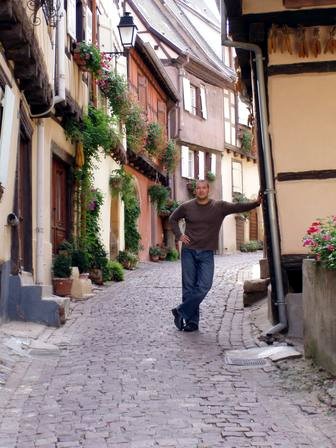
Friday, July 04, 2008

L'Isle sur la Sorgue


L'Isle sur la Sorgue is a village located somewhat downstream from Fontaine de Vaucluse, lower on the plains of the Luberon Valley. It is famous as a town for the sale and purchase of antiques. It has several waterworks throughout the city, along the river which harnessed the power of the river for textile, grain, and mechanical mills.

It was a perfect place for lunch, and a cute town. Lots of tourist shops, with olive oil, lavender soaps, etc...

On the way there, we were not far from Lacoste, where the Marquis de Sade maintained a residence (now the ruins are owned by Pierre Cardin, and there is a summer theatre series given there...) We also passed by a village of cliff-homes - people actually live in caves built into a cliff, and have since prehistory - they still live there today as well, in much modernized versions...

More photos here on my flickr.com site:

Fontaine de Vaucluse


The Fountaine de Vaucluse, for which the entire department is named, was just a short side trip from the main road between Avignon and Gordes. It is pretty famous as one of the largest springs in the world - essentially an entire raging river flows fully formed, directly up from a hole at the base of some high cliffs and becomes the river Sorgue. When we were in the area, Francois was not even sure that the village was open to visitors - the recent rains had swollen the river to much more than the normal flow rate - I think he said something like 200 cubic meters of water per second were flowing up from the earth recently, causing the officials to limit access to the area out of concerns for safety! (That sounds ridiculously high, but I looked up the spring online, and the annual flow rate is about 630 million cubic meters per year, or an average of about 20 cubic meters per second, so 200 would only be ten times that....)

Needless to say, this is a huge amount of water. And a lot of the success of Provence as a historically rich farming region is due to the availability of this water for irrigation and more importantly for transport to market, and for motive power for linen mills for textiles, grain mills for grain, and to a lesser degree for manufacturing.

The water was roaring and swishing - running almost right up against the bottom of some of the bridges. There was even a low wall along the village square which was barely holding back water from inundating the town. Walking up toward the source, there is a ruined paper mill that you can visit, and a large stone plaza from which you can observe the river as it surges and falls. There is a ruined fortification high over the village as well, looking down on the steep, narrow valley - 'Vaucluse' is apparently adapted from the Provencal words for 'Closed Valley' or something like that.

More photos and videos here at my flickr.com site

Gordes


"Are you ready to see something magnificent" Francois the wine tour guide asked the three of us on his tour. We were winding our way through the Provence countryside, alongside olive orchards and beautiful stone walls everywhere, herbs, lavender, cherry trees in bloom, 'Borries' or beehive-shaped rock dwellings from long, long ago.

We all said that we were, but as we rounded the corner I was still stunned by the view before me. Towering over the valley that stretched off to the mountains in the distance was a beautiful village, seemingly carved out of rock, clinging tenuously to the side of the cliffside. Gordes.

Apparently, this is one of the sights for which Provence is famous. It is so stunningly beautiful that it has attracted a long list of famous people who live or have lived here. It is the village that Francois Mitterand lived in, and apparently the Princess of Monaco has a home here, where Princess Diana was to have come to live with her. There are other French movie stars who keep homes here as well.

I walked the streets, which seem to go mostly up and down, except for at the top plaza portion of the city at the top of the hill. There is a fortification here, plenty of shops and bakeries. You get the sense that this is a touristed place, but that also people manage to live their lives still.

Below, the fields stretched out on the plain, orchards, vegetables, vineyards, small farmsteads. Very beautiful!

More photos here at my flickr.com site

Thursday, July 03, 2008

Rousillon


In Avignon, I signed up for a full day wine tour with a local guide. Francois was the perfect guide for me - he speaks English, French, Spanish and Portuguese. In addition, he had worked for 15 years as the Maitre D' for a top restaurant in Avignon, (until he and his wife started a family together, and he didn't want to miss her childhood while he was working long hours,) so he knew all of the domaines from his business interactions with them, purchasing their wines, etc... On top of that, his wife is an Oenologist and works in sales for a French firm that sells winemaking supplies to wineries, so he is very well versed in the technical aspects of wine as well.

Francois already had 2 clients lined up, a very nice retired couple from England. They were not hugely into wine, but they did want to see the region, so Francois apologised that we would be spending the first half of the day sightseeing around some of the villages in the area, and then we would go to Chateauneuf du Pape for the afternoon.

This was fine with me, and I loved streaking along the Durance River, seeing the Cherry orchards being harvested by men on tall ladders, seeing fields of lavender not just yet in bloom.

One of the villages that we visited was Rousillon, located high atop a hill. As we drove through the pine forest up to the village, quarries could be seen on the side of the road, bright, chocolate red with Ochre, which has always been mined here - in fact it is traditional for the people to plaster their homes with it, and as we gained the village at the top of the cliffs, it was a mass of reds, oranges, yellows, and other rich earth tones of ochre.

The view from the top was beautiful, the mountains, the rivers, the fields and vineyards that stretched out below. The tiny cobbled streets, the churches, and the windy gardens at the very top of the town.

More photos click here

Sunday, June 29, 2008

Avignon


I intentionally did not plan my entire trip before leaving for Europe. I like the flexibility of several unplanned days; I like being able to say ‘Yes’ to opportunities that crop up, and I like getting the lay of the land and a sense of what else is available nearby. I will point out that this has led to some disasters in the past – but on the whole, being open to the moment has brought me great memories, experiences that have broadened my understanding of this world, and in several cases new friends who continue to enrich my life every year.

I weighed the options – I could go back to Barcelona, or I could stay in Montpellier for a longer period of time – or I could do something else entirely. Barcelona had proven to be beautiful and exciting, but also quite expensive, and I knew that I would have at least one more night in the city before flying out from the airport. Montpellier was great, and I had been enjoying it a lot, but I wanted to see more of the countryside.

Marseille was not far away, and reputed to be France’s second city, after Paris. Nice and Cannes were also within reach, with great beaches, etc… But the weather was still cloudy and cold.

In the end, I decided to go to Avignon. It was right on the rail line to Lyon, situated in the midst of the Cotes du Rhone wine region, with the famous rocky vineyards of Chateauneuf du Pape just a few miles outside the walls of the city, and within the historic kingdom of Provence.

It was an easy 1.5 hour ride to Avignon, with castles and cities, rivers, windfarms harnessing the energy of the Mistral, and as we approached my destination more and more vines and orchards. Departing the station, the ancient walls of the old city are immediately in front, amazingly well-preserved and dominant. My hotel was immediately up the main street about a half-mile, and I just walked with my rolling suitcase. I am glad that I did, as the choked, narrow main way was so crowded that a taxi would have taken twice as long. After a short nap and a change of clothes, I went out to walk in the narrow, medieval streets to get my bearings.

My hotel was right by the center place, with the city hall and its impressive clock. Lots of street restaurants, tourist shops, and shopping everywhere. Within 3 blocks or so was the Palace of the Popes – immense and imposing, with a small cathedral adjacent. Avignon actually functioned as the seat of the Popes for about 100 years – the papacy lived in exile from Rome, due to political instability and infighting that made them feel not entirely safe. The Avignon popes lived under the protection of the French king of that time – though the city of Avignon was still within the Holy Roman Empire at that time, France began just across the Rhone river. The residence of the popes in Avignon brought a huge amount of fortune in the form of trade, commerce, and political and religious importance to the region – this is reflected in much of the fortification and architecture in this region. (And the city remained a possession of the Catholic papacy from 1348 until the French Revolution in 1791.)

Avignon is situated near the confluence of the Durance and Rhone rivers, which have always been important to trade – even today the Durance provides huge amounts of water for irrigated agriculture in the Provence region, and river barges can enter the mouth of the Rhone and follow the systems of canals ultimately as far as Paris and the North Sea!

Wandering around the walls to the Pont d’Avignon (bridge of Avignon) which once connected the Roman Empire to neighboring France just across the river, (only a few of its arches still remain,) I learned that when the river crests and threatens to flood the city, they can close the tower gates, barring them, and the walls keep the river from inundating the streets and businesses within the walls. Not bad, to think that even 800+ years later these walls are protecting the city!

It was really windy, but I climbed up the towers from the bridge side to a rocky garden atop the cathedral area – from here one can look out over the countryside, seeing the river stretch off into the distance – Mt Ventoux, the beginnings of the Alps, over the rooftops of the city, and the jagged toothlike low range called ‘les Alpilles,’ which were painted famously by Van Gogh.


Click here for more photos from Avignon and surrounding areas on my flickr.com site.

Sunday, June 22, 2008

Je t'aime, TGV


I just need to point out here how much I truly love the TGV; or rather rail travel in general throughout Europe. Speeding from city center to city center in very little time, efficient, on schedule, frequent, comfortable, relatively clean and through interesting countryside. The TGV has almost eliminated commercial air travel within France, as it is so much more convenient to simply take the train, with similar travel times, less stringent security screening (though in Spain it looked like they were getting more serious about it on some routes, no doubt in wake of the Madrid bombings,) and generally you can grab a metro from near your home to the main railway station, eliminating the need for parking hassles, etc... Even the local trains are very quick, and since they run on electrical lines overhead, they don't kick out pollutants non-stop, and are fairly quiet compared to the big Diesel-Electrics on American rails. (We know, we used to live next to the train station in SLO!)

I am sure that someone might point out how European rail travel is imperfect, or subsidized by the government, etc... But think about how we subsidize the auto industry in this country, with our road building and maintenance, our billions-of-dollars-a-week oil wars, publicly funded parking structures, etc... Or the way we keep bailing out the domestic air carriers when they fail to manage their businesses effectively (though Southwest is proving that a company can cut costs while keeping service at a high level, providing some of the lowest fares by ensuring its bottom line is healthy - without government handouts or nickle-and-diming its clients.)

Rail travel here in California is a far cry from that of Europe. I took an Amtrak train from San Luis Obispo to Martinez CA last year, when I had a meeting up in Sonoma, and a ride home available. It was a study in mediocrity. The trip took nearly 8 hours, (driving takes about 4-5 hours,) the train was nearly empty of people. The train was slow - we had to pull over numerous times to let freight trains pass. Mostly, it traveled through the industrial areas of the towns we went through, although the scenery on the Central Coast is pretty amazing to look at (particularly on the way south, along the ocean toward Santa Barbara.) The train was filthy, the windows were all smudged, so it was tough to get a good view outside. The interior was stuffy and uncomfortable, the food that was available was comparable to that available in a second or third-tier gas station. I at least expected that there would be a wireless internet connection, so that I could be somewhat productive on the journey, but no, not even that was available. And with crappy schedules, I could only arrive at 11pm in Martinez, the train station nestled alongside a grubby portside oil refinery with no travelers amenities at all - had to wait 20 minutes for a cab to arrive after the station master locked me out in the drizzle.

Imagine if there was a high-speed train available on this route instead. At 150-200 miles per hour, a trip into San Francisco could be cut in half - even with a number of station stops, it would take less than 2 hours. Or Los Angeles to San Francisco in 3 hours, even with stops in San Fernando Valley, Ventura, Santa Barbara, San Luis Obispo, Salinas, San Jose? I have to think that ridership would be very high, particularly with the frustration involved in getting to LAX / SFO with your car, security clearances, flight delays, etc... And using electric energy rather than gas is a no-brainer - most of California is so sunny that a large amount of the daytime need could be met by solar arrays along the right-of way, with nighttime runs using less expensive off-peak transmissions.

What if we could cut the number of cars driving back and forth on highway 5 & 101 by a few hundred thousand a year? Maybe millions of trips a year? That would have to do something good for the oil situation, right? Probably a lot faster and a lot more permanent solution than drilling in the Arctic, or off the coast of South Beach for oil that we couldn't fill our tank with for at least another 15-20 years?