http://www.kingcorn.net
This was a great movie, available via the Netflix instant online view application.
Follows one acre of corn in Iowa for a season, tracing how this crop is grown, how it has affected small town America, and how it is finding its way into everything that we eat and especially drink. Very worthwhile to watch - at least the trailer, which is available at the movie's website - http://www.kingcorn.net/
Showing posts with label sustainability. Show all posts
Showing posts with label sustainability. Show all posts
Sunday, September 14, 2008


Saturday, September 13, 2008
Email Interview - Paso Robles
I was contacted by a writer doing a story on EOS winery for a Swedish wine publication (apparently, we export a fair bit of wine there?) She wanted to do a sort of email interview as a preliminary, and came up with some questions to start the conversation - since I put some thought into the answers, and since they sum up a lot about how I feel about Paso Robles and Sustainable Agriculture, I am putting them up here as well for friends to see and comment upon. Cheers!
1.
1. Please tell me about your background in the winemaking business.
· I trained at University to be a Marine Biologist; I have always been fascinated by the natural world and the way natural systems find their own order. To pay my way through college, I began to work in restaurants where wine was a central feature of the dining experience, and to taste seriously with and learn from the experienced staff members. In this way, I really came at wine from the restaurant side, and this eventually presented me opportunity to enter wine production professionally. I was working in Santa Barbara at Michel Richard’s restaurant Citronelle, when I met some of the people from Sanford winery, just over the mountains in the lower Santa Ynez Valley, (now the Sta. Rita Hills AVA.) I had always loved their wines, and volunteered to help by cleaning out tanks, or rolling barrels around; whatever I could do to learn more about how wine was made. I was given a 2-day a week job, and once exposed I never looked back. This industry was very welcoming; it was a good fit for my scientific side, yet offered a creative outlet in a way that the world of academic science didn’t do; being able to look back at the end of the day or week, or year and say ‘Hey, we did this!’ And being in an agricultural pursuit felt entirely natural to me, as I grew up within the cycles of seasons and in close dependence upon the earth. I bit the bullet, and left the world of restaurants to take a minimum-wage job with another Central Coast winery, and it was one of the best decisions of my life so far. From that point, I have worked primarily on the Central Coast, with one vintage spent in Oregon. My most recent position was as winemaker for a company that had their own 750 acre estate Pinot Noir and Chardonnay vineyards, as well as a large two-facility custom winemaking operation which made wines for companies throughout California and the world. This was a great place to see how the ‘big guys’ played the game, and to work with fruit of all quality levels from throughout the premium winegrowing regions within California. I got involved at every level and in every aspect of the world of wine business and wine technology.
2. You decided to join EOS Estate Winery in April 2008, what was you
main motivation behind this decision and what do you hope to
accomplish?
· I’ve always believed that if you push yourself to excel and refuse to play small because it feels ‘safe’ you will be presented with opportunity to positively affect the world around you. I look around and see how the consolidation in the world wine business is really squeezing farmers and small wine businesses – these corporations need to present their shareholders with profits, and they often find the profit at the expense of their grower partners. When Sapphire Brands acquired EOS Estate last year, and announced plans to take it to 100% solar-powered, I knew that this was a company that was ready to do things the right way. EOS is a large enough winery (~4000 tons annually) to have an important impact, for the better or for the worse, upon the Paso Robles appellation – and I am determined to be a part of steering this thing in the right direction. We are putting a lot of wine into the world-wide marketplace with the words “Paso Robles” on the label, and I owe it to all my growers, and to all the other winemakers and wineries around us to make sure that those words stand for quality, for excellence, for value, and for environmentally and socially responsible choices. At the same time, we are really just the ‘little guys’ in the world of wine – we have to work harder, think smarter, be more nimble and turn out better quality in order to compete in a world where we have very little weight to throw around with distributors and ‘Chain’ accounts, and no budget to ‘buy’ our way in. We rely upon relationships as number one priority – with our growers, with our distribution partners, with our employees, and with our customers. Relationships are maybe even more important to our business than our buildings, vineyards and equipment.
3. What, in your opinion, makes EOS and its wines unique? What is your
proudest achievement during your time at EOS?
· EOS draws from vineyards throughout the large Paso Robles AVA – this gives us access to very diverse vineyard resources, and to diverse people with varied viewpoints on how to best achieve quality – some of the best minds in sustainable agriculture are working with us on a daily basis. I was drawn to EOS by the even hand and consistent quality which has been their hallmark – elegance and understatement stylistically, and a commitment to putting top quality wine into bottle at a price that is approachable for everyone. We are in a period of change currently, but when the medium is wine, change always comes slowly – over the course of years, rather than weeks or days. In that context, I am really just at the beginning of my time here, and though there have been important achievements, they are mostly of the sort that will show dividends in several years, rather than immediately. I have really set to work on defining stylistic goals for our winemaking – many winemakers will give good verbiage about “listening to the grapes, and letting them become what they wish to be.” Well, as one of my mentors in this business likes to say, “what grapes really want to do is to become vinegar, not wine!” Quality wine starts with time spent in the vineyard, and with clearly communicating expectations to the growers and vineyard managers, and hearing and learning from their experience. By the time the fruit arrives at the winery, my ability to affect the final outcome of the fruit is minimal – it is more about preserving the quality that is already inherent in the grape; I can’t increase the quality through what I do in the cellar, I can only avoid harming it. Stylistically, I want to refine our goals further, and bring a touch more modernity to our wine style. I’ve travelled to wine regions around the world over the past several years, and there are two main things that just this summer struck me and will define my winemaking to some extent; A.) We can sometimes take our wines too seriously in California, everyone is chasing the next ‘impressive’ wine. Traditional wine regions certainly have their share of these, but they also have a great hand with just plain ‘likeable’ and delicious everyday wines, and B.) Many California wineries try to define themselves as ‘Burgundian’ or ‘Bordeaux’ or ‘Italian’ in style – almost in the way that decades ago, American restaurants only felt that they could be of quality if they had a French or Italian name, menu, and décor. Those days are over for cuisine; chefs everywhere have embraced their own local heritage and ingredients, and it is time for the wine business to have some brave companies and winemakers step forward and proudly show our own style, our own ingredients, and contribute something unique to the world of wine – this is happening slowly too, but gathering force.
4. Please tell me about your views on sustainable agriculture and how
this affects your work at EOS.
· I grew up in rural Minnesota at the time that the small family farm was going extinct one by one as the suburbs sprawled, and the next generation went off to work in more financially lucrative careers. Both sets of my grandparents had farms of less than 500 acres each, but they also had outside jobs that made that possible – they farmed more out of tradition and love of the land than for the income that was derived from their efforts. Of their children, only 3 have continued to be involved in agriculture – two in agricultural support careers, and one uncle farms part-time the original family place built by my great-great grandfather when he arrived from Sweden in the late 1800’s, in addition to his career in technology in Minneapolis. I believe that I am the only member of my generation that is still involved in agriculture at all. In Paso Robles, agriculture is still viable for small farmers because the wine business depends upon, and rewards quality. Industrial agriculture has encouraged and stimulated the creation of standardized commodity markets for many agricultural products in the United States to the point that yield and efficiency are the only attributes that are rewarded by the market. Under these systems, large, ‘efficient’ companies using high levels of chemical inputs and operating on tight margins are driving smaller farmers out of the arena. I hope that we can work with and reward growers of all sizes whom are committed to quality and sustainability – the Central Coast has been at the forefront of sustainable agriculture in vineyards, and some of our growers are in the pilot program for the Central Coast Vineyard Team’s “Certified Sustainable” effort. By coming up with an objective certification program, hopefully the market will financially reward growers who are going to the extra steps to ensure that they are doing the right thing for our business and our environment for the long-run.
5. Which are the key advantages of winemaking in Paso Robles? The main
challenges (if any)? Please give a brief description of the region´s
climate and weather patterns and how these affect the quality of the
grapes and wines.
· The Paso Robles AVA is a relatively large appellation, with a lot of variation in soils, local climate, topography, and viticultural philosophy. This is both a blessing and a challenge – you can not apply the same technique in two vastly different locations and expect the same result. Though the old standard grape varieties of Cabernet Sauvignon, Merlot, and Chardonnay are still the dominant plantings locally, there are growers experimenting with nearly every variety imaginable; varieties native to Italy, France and Spain, as well as ‘American’ varieties such as Zinfandel and Petite Sirah – some of these vineyards now have vines of great age. Rhone and Mediterranean grape varieties have really attracted a lot of attention here locally, and seem to fit perfectly into our climate and growing conditions. There are relatively few serious pests to deal with compared to other regions, so chemical usage is very minimal and generally selected for ‘soft’ chemistries. The basic climate is balanced on a razor’s edge between the cool Pacific Coastal region just over the Santa Lucia Mountains to the West, and the hot, dry inland climate of the southern San Joaquin Valley about 2 hours drive inland to the East, (it’s about 15-20 miles through the mountains between the town of Paso Robles to reach the ocean.) The days are hot during the growing season – 95-105F degrees is quite common; but as the inland regions heat up, the rising air pulls in cool breezes and fog from the Pacific (year-round temperature of about 48-55F degrees,) through several gaps in the mountains, which cools the entire region beginning an hour before sundown or so. Nights here are generally cool, around 50-55F degrees. Warm days help to build rich fruit flavors and soft tannins into the grapes on the vine, while discouraging fungal diseases, and the cool nights help to preserve color and aroma, and allow the vines to recover water and mineral balance and ‘catch-up’ from the heat of the day.
6. What, in your opinion, makes Paso Robles such a thriving viticultural region?
· It’s the people. The Paso Robles wine region is populated by passionate, determined people from a variety of backgrounds who are dedicated to constant improvement of farming, winemaking, and marketing our wines to the world. We have a world-class Agricultural & Business University in the form of Cal Poly just 25 minutes to the south, and their newly-formed Enology and Viticulture department is already releasing dynamic, enthusiastic young people into the industry throughout the state. Though Paso has in the past sent much of its fruit north to the big wineries who use our vineyards as sources for large regional blends, there is a trend toward more and more of the fruit being fermented and marketed by local vineyards who proudly proclaim “Paso Robles” on the label. There are small wineries who have become the darlings of the media as they push the limits of viticulture and enological style, attracting attention to the entire region. And there are larger wineries whom have shown how strongly the wines from this region can compete on a national stage. We are still working on increasing the knowledge of our region with the average wine consumer – we aren’t as recognizable as Napa or Sonoma yet, and we will always have a different meaning in people’s minds than those areas. But we are building our reputation by leaps and bounds, and are rapidly becoming an exciting new quality and value region that wine drinkers are embracing and enjoying and sharing with their friends, and making a part of their lives. We are a leader in responsible environmental vineyard development and management – we are a choice that people can be comfortable making. This is a dynamic and constantly developing region – stay tuned as we continue to define ourselves and push quality higher – I’m excited to be a part of the coming years!
Sunday, June 29, 2008
O2 Wine & MacroWine

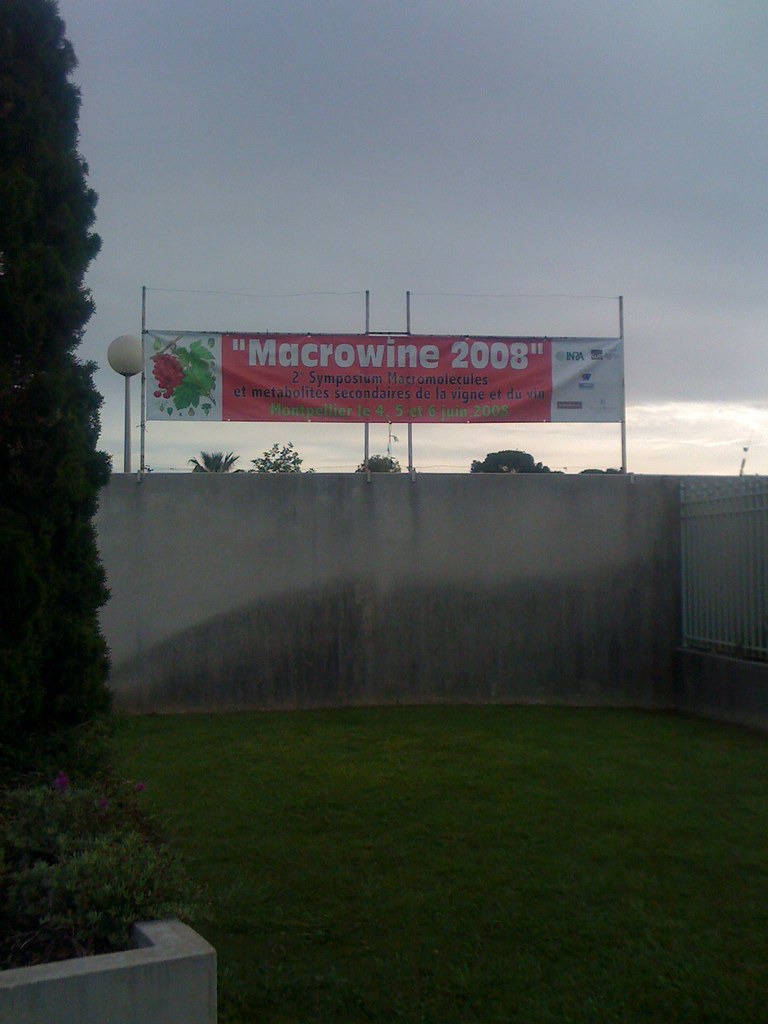
I realize that I have neglected to mention much about the very reason that I ended up in Montpellier. I was in town to attend two wine science conferences – the first, ‘O2 Wine,’ was the first annual gathering of an industry / academic partnership by the same name which is dedicated to defining and in some cases funding needed research into the interaction of oxygen in wine at all stages from crush through bottle aging. It is made up of members from primarily industrial equipment and materials suppliers, as well as laboratories and scientists affiliated with the top wine universities and research institutions in Germany, Australia, France, South Africa, Spain and the United States. The second conference is called ‘MacroWine’ and it is the second annual meeting of this group, which has a similar mission, but is more related to uncovering the secrets of macro-molecules in wines, such as tannins, polyphenols, colloids, proteins, and protein / phenol complexes and the way that they influence wine quality, sensory perception, and stability.
(I was invited to attend by a synthetic closure company whom I have been in contact with following (or rather during, as it is still ongoing,) a production-level trial in which I have been following the development and aging of a wine that was finished with a variety of closure types, including screwcaps, synthetic corks, natural corks, and an engineered cork closure. All of these products allow varying amounts of oxygen into the bottled wine during aging, and thus provide different rates of oxidation, different life spans for the wine, and different sensory results in what was at one time an identical wine.)This was a pretty heavy week of information – much of what was presented was very academic and assumed a daily familiarity with the subtleties of organic chemistry, protein and enzyme synthesis and activity. It was very cool to be seated in a room with some of the best names in wine science – I seriously know most of these guys from reading the papers that they have published in AJEV and other research publications that are becoming foundational to these fields of research. Several of the presentations dealt with laying the basics – what are the best methods to categorize and measure such complex and diverse groups of chemical species – the scientific equivalent of building a language that can be understood and used by all who are pursuing research in these areas. Secondly, these kinds of meetings of the best like-minded scientists in the world can only lead to more rapid advances and better understanding for the industry as their discoveries are shared and cross-pollinate and illuminate one another. The industry affiliates whom are largely funding this group are also poised to be the first to benefit as they incorporate and have access to the minds and information that are involved.
I am sure that this will lead to better products, better understanding, more rational winemaking, and ultimately better wine made in a more efficient way in the future. Not quite at the level of curing cancer, (although some of the phenols involved are being shown to do just that, so who knows!) but I believe that better wine is a cause we can all get behind!
The conferences were hosted at the INRA (Institute National for Research Agricultural) which is certainly well-known as the birthplace of many wine-related improvements. Many of the specific yeast strains that are used worldwide, many of the certified rootstocks and grapevine scions were developed here, and it was very cool to walk along the edge of the experimental vineyard.
Montpellier is actually a strong center of Agricultural research of many kinds – SupAgro (the specific part of the INRA that we met at,) is the nickname for the top agricultural school (Superior Agronomy, or something like that,) in France, and there is another related research facility called Agropolis, basically an academic research campus that is dedicated to developing new ways to farm crops worldwide, with an emphasis on hot-climate agriculture for the developing world, specifically food and cash crops for Africa, Asia, and elsewhere. In addition, this campus hosts one of the most important research projects into the questions raised by agriculture and global climate change. Very interesting place, and very important in the world!
Sunday, June 22, 2008
Je t'aime, TGV

I just need to point out here how much I truly love the TGV; or rather rail travel in general throughout Europe. Speeding from city center to city center in very little time, efficient, on schedule, frequent, comfortable, relatively clean and through interesting countryside. The TGV has almost eliminated commercial air travel within France, as it is so much more convenient to simply take the train, with similar travel times, less stringent security screening (though in Spain it looked like they were getting more serious about it on some routes, no doubt in wake of the Madrid bombings,) and generally you can grab a metro from near your home to the main railway station, eliminating the need for parking hassles, etc... Even the local trains are very quick, and since they run on electrical lines overhead, they don't kick out pollutants non-stop, and are fairly quiet compared to the big Diesel-Electrics on American rails. (We know, we used to live next to the train station in SLO!)
I am sure that someone might point out how European rail travel is imperfect, or subsidized by the government, etc... But think about how we subsidize the auto industry in this country, with our road building and maintenance, our billions-of-dollars-a-week oil wars, publicly funded parking structures, etc... Or the way we keep bailing out the domestic air carriers when they fail to manage their businesses effectively (though Southwest is proving that a company can cut costs while keeping service at a high level, providing some of the lowest fares by ensuring its bottom line is healthy - without government handouts or nickle-and-diming its clients.)
Rail travel here in California is a far cry from that of Europe. I took an Amtrak train from San Luis Obispo to Martinez CA last year, when I had a meeting up in Sonoma, and a ride home available. It was a study in mediocrity. The trip took nearly 8 hours, (driving takes about 4-5 hours,) the train was nearly empty of people. The train was slow - we had to pull over numerous times to let freight trains pass. Mostly, it traveled through the industrial areas of the towns we went through, although the scenery on the Central Coast is pretty amazing to look at (particularly on the way south, along the ocean toward Santa Barbara.) The train was filthy, the windows were all smudged, so it was tough to get a good view outside. The interior was stuffy and uncomfortable, the food that was available was comparable to that available in a second or third-tier gas station. I at least expected that there would be a wireless internet connection, so that I could be somewhat productive on the journey, but no, not even that was available. And with crappy schedules, I could only arrive at 11pm in Martinez, the train station nestled alongside a grubby portside oil refinery with no travelers amenities at all - had to wait 20 minutes for a cab to arrive after the station master locked me out in the drizzle.
Imagine if there was a high-speed train available on this route instead. At 150-200 miles per hour, a trip into San Francisco could be cut in half - even with a number of station stops, it would take less than 2 hours. Or Los Angeles to San Francisco in 3 hours, even with stops in San Fernando Valley, Ventura, Santa Barbara, San Luis Obispo, Salinas, San Jose? I have to think that ridership would be very high, particularly with the frustration involved in getting to LAX / SFO with your car, security clearances, flight delays, etc... And using electric energy rather than gas is a no-brainer - most of California is so sunny that a large amount of the daytime need could be met by solar arrays along the right-of way, with nighttime runs using less expensive off-peak transmissions.
I am sure that someone might point out how European rail travel is imperfect, or subsidized by the government, etc... But think about how we subsidize the auto industry in this country, with our road building and maintenance, our billions-of-dollars-a-week oil wars, publicly funded parking structures, etc... Or the way we keep bailing out the domestic air carriers when they fail to manage their businesses effectively (though Southwest is proving that a company can cut costs while keeping service at a high level, providing some of the lowest fares by ensuring its bottom line is healthy - without government handouts or nickle-and-diming its clients.)
Rail travel here in California is a far cry from that of Europe. I took an Amtrak train from San Luis Obispo to Martinez CA last year, when I had a meeting up in Sonoma, and a ride home available. It was a study in mediocrity. The trip took nearly 8 hours, (driving takes about 4-5 hours,) the train was nearly empty of people. The train was slow - we had to pull over numerous times to let freight trains pass. Mostly, it traveled through the industrial areas of the towns we went through, although the scenery on the Central Coast is pretty amazing to look at (particularly on the way south, along the ocean toward Santa Barbara.) The train was filthy, the windows were all smudged, so it was tough to get a good view outside. The interior was stuffy and uncomfortable, the food that was available was comparable to that available in a second or third-tier gas station. I at least expected that there would be a wireless internet connection, so that I could be somewhat productive on the journey, but no, not even that was available. And with crappy schedules, I could only arrive at 11pm in Martinez, the train station nestled alongside a grubby portside oil refinery with no travelers amenities at all - had to wait 20 minutes for a cab to arrive after the station master locked me out in the drizzle.
Imagine if there was a high-speed train available on this route instead. At 150-200 miles per hour, a trip into San Francisco could be cut in half - even with a number of station stops, it would take less than 2 hours. Or Los Angeles to San Francisco in 3 hours, even with stops in San Fernando Valley, Ventura, Santa Barbara, San Luis Obispo, Salinas, San Jose? I have to think that ridership would be very high, particularly with the frustration involved in getting to LAX / SFO with your car, security clearances, flight delays, etc... And using electric energy rather than gas is a no-brainer - most of California is so sunny that a large amount of the daytime need could be met by solar arrays along the right-of way, with nighttime runs using less expensive off-peak transmissions.

What if we could cut the number of cars driving back and forth on highway 5 & 101 by a few hundred thousand a year? Maybe millions of trips a year? That would have to do something good for the oil situation, right? Probably a lot faster and a lot more permanent solution than drilling in the Arctic, or off the coast of South Beach for oil that we couldn't fill our tank with for at least another 15-20 years?
Subscribe to:
Posts (Atom)